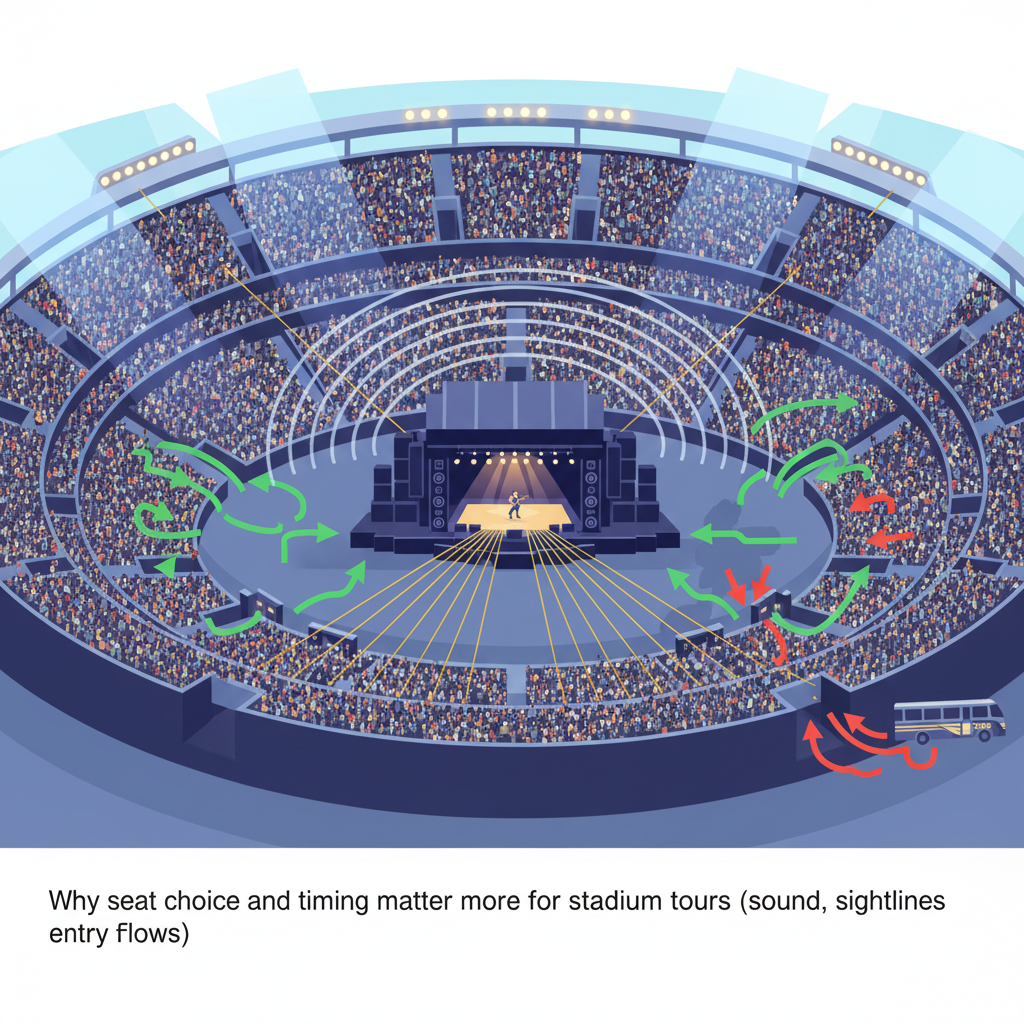
Why seat choice and timing matter more for stadium tours (sound, sightlines, entry flows)
You bought tickets for a stadium tour and still worry: will the singer be a postage stamp, will the sound be muddy, or will you spend an hour in a bottleneck at the exit? Those are real problems. Stadiums hold 40,000–90,000 people and even small differences in seat location or arrival time change your whole night. This stadium tour seat picking guide 2026 helps you pick seats that give you sightlines, good sound, and smoother entry/exit.
Quick answer: choose seats based on view priority (full-stage vs. close-up), arrival windows (GA: 90–180 minutes early; lower bowl assigned seating: 30–60 minutes early; VIP: 45–90 minutes early), and the venue layout (avoid extreme side angles). For stadiums (40k–90k) plan for longer exits—45–120 minutes to clear.
When not to follow this guide: For more on this, see Concerts and events guide.
- If you enjoy being shoulder-to-shoulder and value only front-row access—GA-first-in strategies work better.
- If your priority is cheapest possible tickets rather than experience—this guide assumes you’ll optimize for view and comfort.
- If the event is an intimate arena show (10k–22k) with a non-standard stage configuration—adjust recommendations accordingly.
For stadium shows, plan arrival by seat type: GA 90–180 min; assigned lower bowl 30–60 min; VIP 45–90 min.
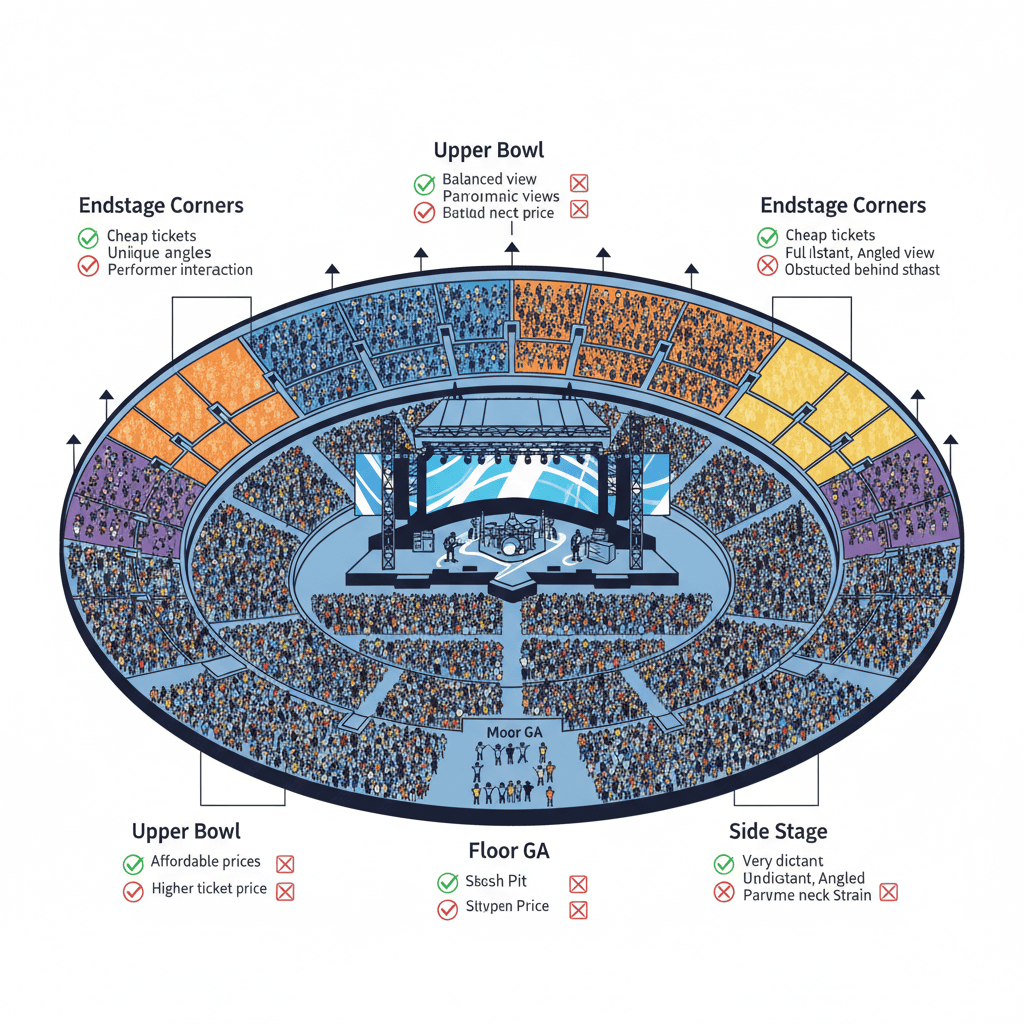
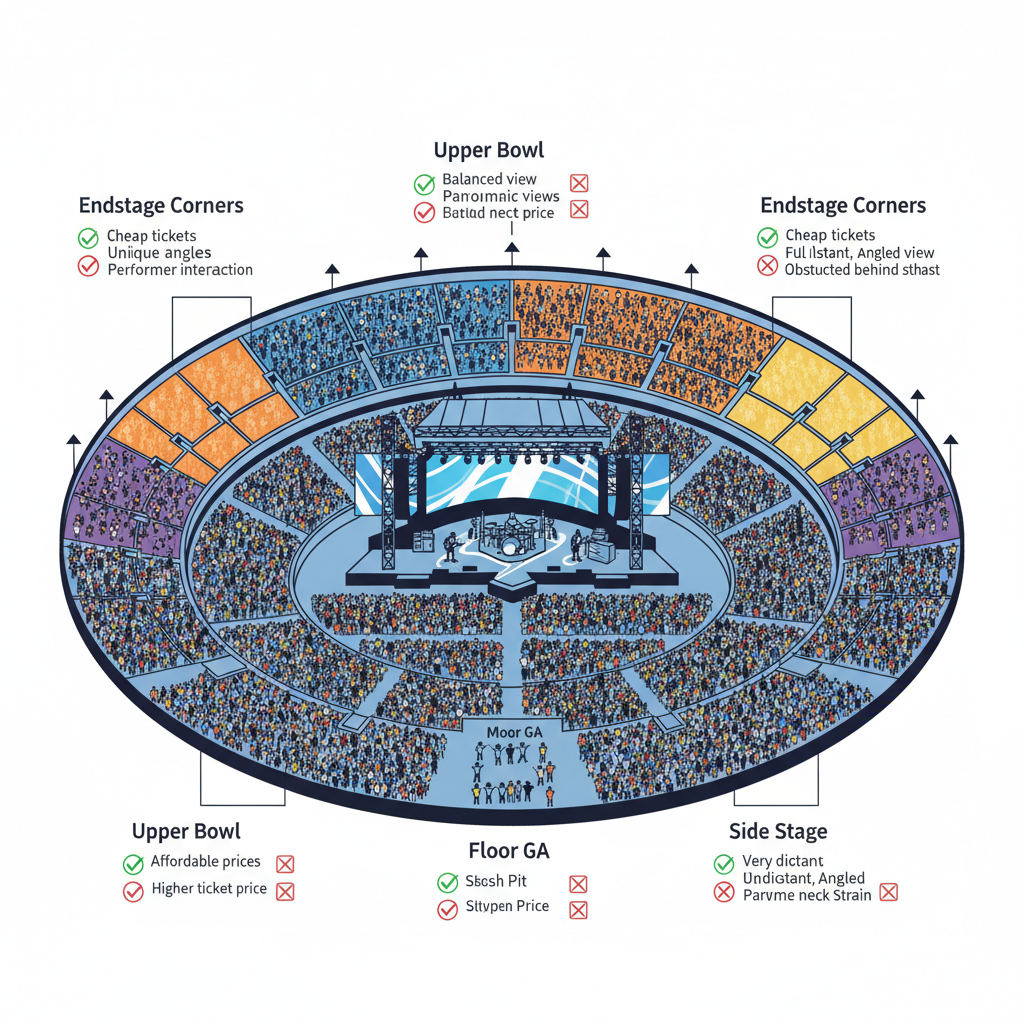
Seat-selection primer — pros/cons: floor GA, lower bowl, upper bowl, side stage, endstage corners
Pick a seat by deciding what you care about: proximity, full-stage view, sound fidelity, or price. Here are practical pros and cons that map to real choices.
| Seat type | Pros | Cons | When to pick |
|---|---|---|---|
| Floor GA | Closest to stage; energy and possible crowd moments | Long lines, limited sightlines if tall people stand, noisy | Want atmosphere and don’t mind standing |
| Lower bowl (assigned) | Close enough for detail, better sightlines, assigned seat comfort | Pricey; some lower-bowl side seats have skewed angle | Balance comfort and show presence |
| Upper bowl | Cheapest views that still show full production | Farther from performers, possible audio delay perception | Prefer budget or panoramic stage shots |
| Side stage / endstage corners | Often cheaper; unique perspective on band members | Can lose stage elements or screens; extreme angles hurt sightlines | Want a deal and don’t need frontal view |
Two quotable seat-selection rules: "Avoid extreme side angles for a complete stage view" and "Lower-bowl center sections usually give the best mix of view and sound for stadium concerts." If you want to know how to choose seats for arena tour vs. stadium, pick arenas for closer, more uniform sightlines; stadiums trade distance for spectacle.
Lower-bowl center seats deliver the best combination of view and sound for most stadium shows.
Visual examples and sightline rules (how to read a stadium seating map)
Reading a stadium map starts by locating the stage footprint, the risers, and any side or end stage elements. The key metric is sightline: the unobstructed angle between your eye and the stage. Look for sections where rows curve toward the stage—those usually preserve sightlines.
Useful sightline rules:
- Line-of-sight rule: if your seat’s view of the stage is blocked by a catwalk, sound tower, or large screen on the map, avoid it.
- Elevation rule: higher rows in the lower bowl often see over heads; one or two tiers up in the same section usually improves view without losing distance.
- Angle rule: avoid seats with a side angle beyond ~60° from center stage if you want a full frontal view (this is a practical threshold, not a technical spec).
For stadium viewing lines and sightlines, compare a seating map overlay with any seat-view photos on ticket sites. For arena tours, the same map-reading applies but scales change: arenas (10k–22k) have steeper bowls and often better consistent sightlines than open stadiums.
Arrival timing by seat type — recommended arrival windows for GA, assigned seating, and VIP
Use arrival windows to trade off queue time versus pre-show perks. Recommended arrival time windows are: GA (90–180 minutes early), lower-bowl assigned seating (30–60 minutes early), and VIP (45–90 minutes early depending on activation). These are practical brackets that work for stadiums holding 40k–90k people.
How crowd density affects exit times: large stadiums can take 45–120 minutes to fully clear after the show. The higher the capacity, the longer egress will be. If you need to catch a train or rideshare, budget for up to two hours exit time for 70k+ venues.
Quotable guideline: "Arrival time for stadium shows should be chosen by seat type: GA 90–180 min; assigned lower bowl 30–60 min; VIP 45–90 min." Plan with slack — a late 30-minute arrival for GA often means you miss key positions.
Pre-show rituals that improve the experience (warm-up spots, merch timing, early photo ops)
Pre-show plans make the night flow. Good stadium concert pre-show tips include: hit merchandise early (first 30 minutes after doors) to avoid long lines later; scout warm-up spots like fan zones or official activations that open before doors; and schedule a quick photo-op near the stadium facade before it fills up.
Practical sequence: arrive in your recommended arrival window, drop off bags at a coat/locker if available, hit merch and restrooms, then claim your entry position (GA lane or seat). If you’re using mobile tickets, screenshot or download them before you reach the gate to speed entry.
Doors, entry gates and security — common stadium policies and bypass hacks
Most stadiums keep similar security lines: bag check, metal-detecting wands, and ticket validation. Common policies include clear-bag rules, prohibited items lists, and mobile ticket-only entries. Legal, practical tips that speed you through include traveling with a clear bag or no bag, arriving at non-primary gates (if your ticket allows), and using contactless payments at concessions.
Do not attempt rule-bending or unauthorized access. Instead use legitimate time-savers: join bagless lanes, use venue-approved fast lanes (VIP/CLEAR), and arrive inside the recommended window so staff can process you before peak queues form.
Accessibility, family sections, and group seating logistics
Stadiums reserve accessible seating and family sections—these usually appear on seating maps and require specific ticket types. If you require accessible seating, select those ticket categories early and contact the venue for elevator and drop-off details. Families often prefer lower-bowl rows with easy aisle access and nearby restrooms.
Group seating logistics: for groups of 6+, request adjacent tickets at purchase or use the venue’s group sales; touring parties that split between GA and seats should designate a meeting point and a time window to regroup after the show. For TourInfo users, note the ticket listing details that flag accessible or family-friendly sections when comparing offers.
Case studies: sample stadium plays for three venues (MetLife Stadium, Wembley Stadium, AT&T Stadium) with recommended gates and arrival times
These are example plays, not exact gate directions—always check your event page.
- MetLife Stadium (large, 80k+): arrive 60 minutes early for lower-bowl assigned seats; GA should arrive 120–180 minutes early. Use secondary gates away from main parking lots to avoid shuttle congestion.
- Wembley Stadium (open bowl, ~90k): lower-bowl center seats = arrive 45–60 minutes early; GA 90–150 minutes. Note thicker crowds on public transport exits—budget 60–90 minutes after show.
- AT&T Stadium (retractable roof, 80k): assigned lower-bowl 30–45 minutes early; GA 90–150 minutes. Indoor concourse means merch and restrooms are plentiful—hit merch immediately after entry.
Checklist — what to do 24 hours, 3 hours, and 30 minutes before showtime
Use this checklist to reduce friction.
- 24 hours before: Confirm tickets in your app and download backups; check transport options and event start time; charge phone and portable battery.
- 3 hours before: Leave with transit buffer; eat and hydrate; print directions to recommended gate or save offline map; screenshot tickets.
- 30 minutes before: Be at the entry area; use restrooms (lines shorter inside); if GA, join the correct wristband/queue area; set a meetup point for after the show.
CTA — link to stadium event listings and ticket-comparison pages on TourInfo
Ready to compare seats and times for the 2026 tour season? Visit TourInfo to view event listings, compare ticket offers, and check seat maps before you buy. Use the seat-selection guidance above when filtering results so you pick the best seats for stadium concerts and plan your arrival time for stadium shows with confidence.
FAQ
What does it mean to plan the perfect concert experience? Planning the perfect concert experience means matching your priorities—view, sound, comfort, or price—to seat choice and timing so you spend less time in lines and more time enjoying the show. For more on this, see Concert experience planning.
How do you plan the perfect concert experience? Plan by choosing the right seat type, arriving in the recommended window for that seat, using pre-show rituals like early merch runs, and following venue security rules to minimize delays.